


GHK-Cu 100mg Peptides
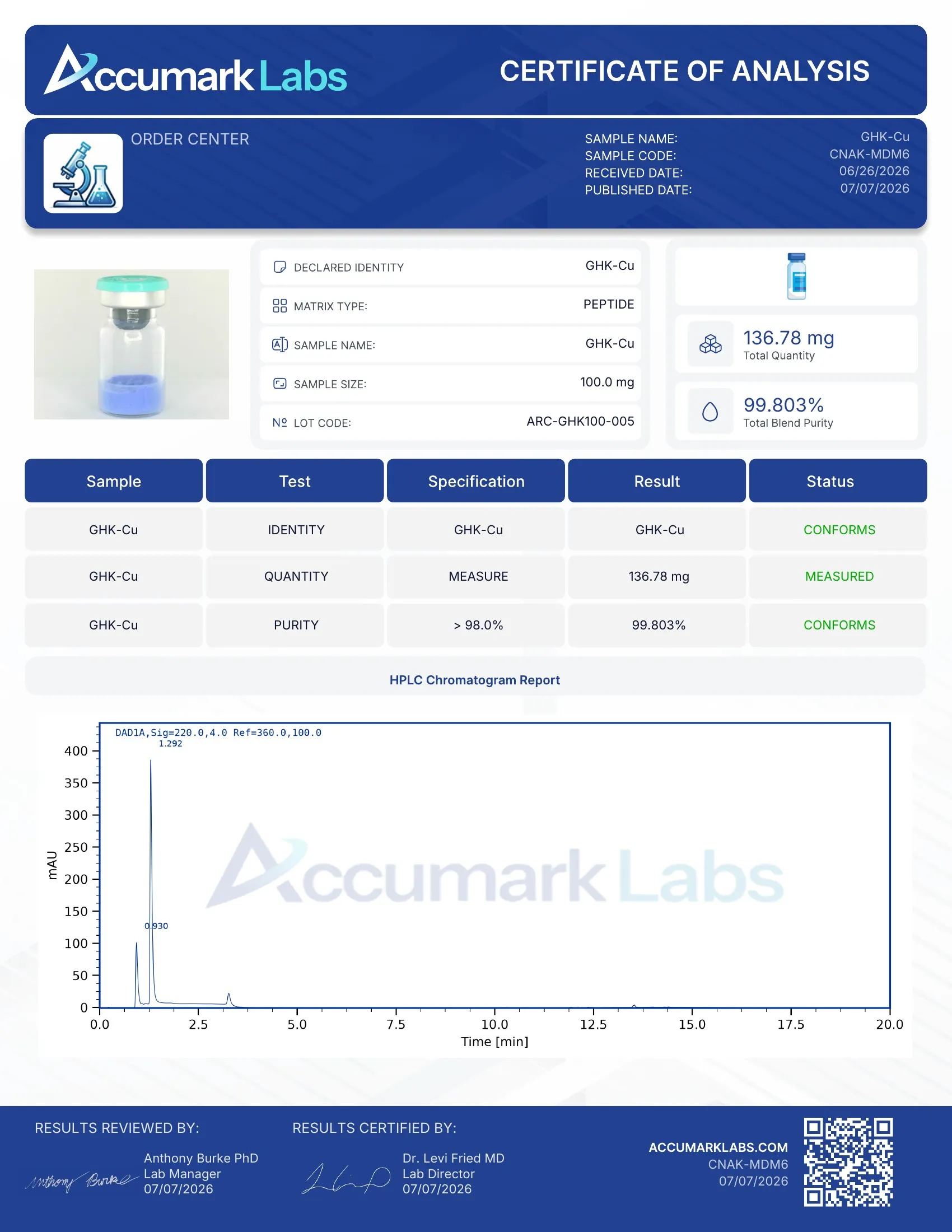
GHK-Cu 100mg is provided as a lyophilized peptide in a single research vial. The supplied material quantity of 100mg is suited to laboratory settings focused on compound characterization and controlled experimental models. This listing refers solely to the GHK-Cu peptide material and its stated quantity and format.
In research applications, GHK-Cu is examined within extracellular-matrix and dermal-matrix signaling contexts, as well as broader receptor-mediated pathway studies. The lyophilized presentation supports accurate material accounting and consistent handling within defined study workflows. Laboratories may structure comparative evaluations and stability observations under standardized conditions appropriate to their methods.
- Canonical compound: GHK-Cu
- Component quantity: 100mg per vial
- Total quantity: 100mg per package
- Physical format: Lyophilized peptide - vial
- Units per package: 1
- Most orders ship within 24 hours and arrive within 3 to 5 days of leaving our warehouse.
- Shipping is free on orders of $99+ (except Hawaii and Alaska).
- All orders ship in discreet packaging via USPS Ground Advantage mail.
Delivery restrictions vary by state.

This Product Contains

Research Applications
Our catalog supports controlled laboratory research across areas such as:
- Cellular Signaling — receptor activity, signaling pathways, and molecular interactions
- Metabolic Research — metabolic regulation and incretin receptor-signaling models
- Neurobiology — cognitive, behavioral, and stress-response pathways
- Immunology — immune signaling and host-response models
- Tissue Biology — extracellular-matrix signaling, cellular migration, and tissue remodeling research
- Mitochondrial Biology — cellular energy systems and aging-related pathways
- Endocrine Research — neuroendocrine and reproductive-axis signaling
- Pigment Biology — melanogenesis and related cellular pathways
Research relevance varies by compound and study design. Review the product information and batch-specific documentation before use. All products are intended strictly for laboratory research and are not for human or animal use, therapeutic use, or clinical application.
Research Materials Backed by Clear Documentation
- 99%+ Analytical Purity Where Confirmed by the Applicable Batch COA.
- Third-Party Testing Performed by an ISO/IEC 17025-Accredited Laboratory, Where Applicable.
- Batch-Specific Certificates of Analysis Available for Applicable Research Materials.
- Ships from the U.S.
Orders are dispatched from our U.S. fulfillment center, typically within 1–2 business days. - Clear Product Specifications
Strength, format, quantity, and available batch documentation are presented for review. - Research-First Standards
Our catalog and documentation are built for laboratory research—not consumer, wellness, or therapeutic use.
Storage & Handling
- Product-Specific Storage
This product is supplied as a freeze-dried material. Keep the original container sealed and follow the storage condition shown on the product label or available documentation.
Follow the format-specific instruction shown above. Product-specific label or documentation requirements take priority over the general handling guidance below. - Keep the Original Container Sealed
Until the material is needed for laboratory work, keep it in its original sealed container. Protect it from moisture, unnecessary light exposure, and avoidable temperature fluctuations. - Inspect the Package on Receipt
Check the container, seal, and packaging for visible damage, condensation, or signs of a temperature excursion. Record any issue before placing the material into laboratory storage. - Document Laboratory Handling
Record the material name, batch information, receipt date, storage location, and relevant handling conditions according to your laboratory’s procedures. - After Opening or Preparation
Once the original sealed state changes, follow the product documentation and your laboratory’s validated protocol. Clearly label any prepared material with the preparation date, composition, and applicable storage condition. - Avoid Unnecessary Temperature Cycling
Minimize repeated warming and cooling. Avoid repeated freeze-thaw cycles when frozen storage is required by the applicable protocol. - Use Material-Specific Conditions
Storage requirements can differ between lyophilized, liquid, and prepared materials. Do not apply one temperature, solvent, or stability period to every product.
Reliable U.S. Order Fulfillment
- Order Processing
In-stock orders are generally processed within 1–2 business days, Monday through Friday. Orders are not processed or shipped on weekends. - Standard Delivery
Domestic delivery typically takes 3–5 business days, depending on the destination and carrier. - Shipment Tracking
Tracking information is provided after the order ships so delivery progress can be monitored. - Careful, Discreet Packaging
Each order is packed with care to help protect the contents and maintain privacy during transit. - Nationwide U.S. Shipping
Orders can be shipped within the United States where permitted by applicable federal and state law. - Possible Delays
Carrier conditions, weather, holidays, backorders, and periods of high order volume may affect processing or delivery times.
Why Researchers Choose Better Molecule
Not all peptide vendors hold themselves to the same verification standards.
| VERIFICATION STANDARD | Better Molecule | GENERIC VENDORS |
|---|---|---|
| Purity Standard | Batch-Specific Analytical Purity — See Applicable COA | Often Not Disclosed |
| Third-Party Testing | Independent Laboratory | Testing Source Often Unclear |
| COA Published | Batch-Specific COA Available | Inconsistent Availability |
| Batch Traceability | Product, Strength & Lot Matched | Batch Match Often Unclear |
| U.S. Fulfillment | Ships Domestically | Often Ships From Overseas |
| Research Use Standard | Clearly Defined | Standards May Vary |
Frequently Asked Questions
Find answers to common questions about this product, its research context, Certificates of Analysis (COAs), ordering, and laboratory use.
Researchers most often study GHK-Cu for collagen-related signaling, dermal remodeling, cellular migration and extracellular-matrix regulation in dermal matrix research models. Supplied for laboratory research use only.
GHK-Cu is a copper-binding tripeptide, short for glycyl-L-histidyl-L-lysine copper. It is one of the most recognized peptides in dermal matrix and cellular-migration research because copper binding changes its biological activity. On a research website, it is described as a laboratory peptide studied for extracellular-matrix and remodeling pathways.
Collagen itself is a large protein built from long polypeptide chains of amino acids — primarily glycine, proline, and hydroxyproline — organized into a characteristic triple-helix structure. Shorter peptides enter collagen research in two main ways: as signaling peptides studied for their ability to influence collagen expression in fibroblast models, and as carrier peptides that deliver cofactors relevant to collagen synthesis, such as copper.
So peptides and collagen are not the same thing, but they are biochemically related. Peptides are studied as small informational molecules that interact with the cellular machinery responsible for producing collagen, which is itself a much larger structural protein.
Signal peptides are short sequences studied for their ability to mimic fragments of larger proteins and trigger downstream responses in cell models — for example, fibroblast responses relevant to extracellular matrix research. Carrier peptides are studied primarily for their ability to transport trace elements or cofactors, such as copper, into cell systems. Neurotransmitter-modulating peptides are investigated in models of neuromuscular signaling and, in cosmetic-adjacent research, sometimes as structural analogs of botulinum-like sequences.
These are research classifications, not therapeutic categories. All of them are studied in vitro, and the distinctions reflect mechanism-of-action hypotheses rather than any approved clinical use.
Cosmetic peptides are short chains of amino acids studied for their interactions with pathways relevant to skin biology — including collagen expression, extracellular matrix assembly, pigmentation signaling, and barrier function. They are commonly grouped into signal peptides, carrier peptides, enzyme-inhibitor peptides, and neurotransmitter-modulating peptides based on their research mechanism of action.
In a research context, cosmetic peptides are investigated as model ligands for fibroblast response, in vitro cellular-migration assays, and skin-equivalent models. The compounds offered by Better Molecule in this category are lyophilized research materials intended solely for controlled laboratory investigation and are not cosmetics, drugs, or consumer products.