


GLP-3 RT 50mg Peptides
When precision matters, choose a peptide built for disciplined research and consistent results.
Better Molecule GLP-3 RT is a lyophilized research peptide presented in a sealed vial format with a total content of 50mg. Engineered for laboratory workflows, this GLP-3 RT preparation is designed to support controlled in vitro experimentation, analytical method development, and repeatable assay performance. The uniform lyophilized matrix enables reliable handling from reconstitution to aliquoting.
- Each vial contains 50mg of GLP-3 RT, suitable for receptor-binding studies, stability and compatibility assessments, and protocol optimization in research settings.
This non-edible, lab-focused format is selected for predictable reconstitution and smooth bench-top handling. The compact lyophilized cake is crafted to dissolve cleanly with an appropriate research diluent, supporting clear solutions, consistent pipetting, and low-variability aliquots. Whether you are establishing a new method, running comparative analyses, or scaling a validated procedure, the goal is the same: dependable material performance that respects your controls and minimizes noise across replicates.
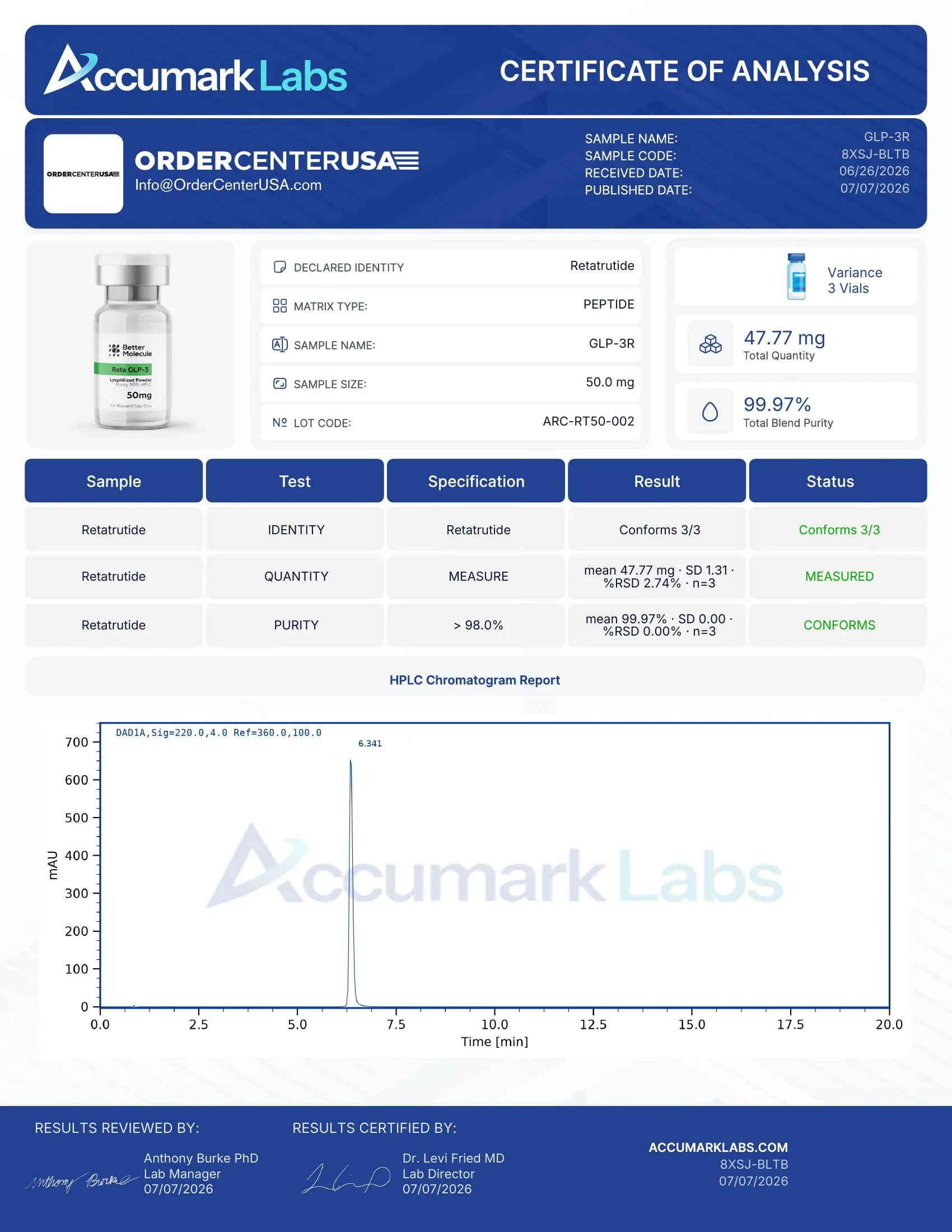
From sourcing to final fill, Better Molecule prioritizes material integrity. Each batch is produced under stringent quality controls and is evaluated for identity and purity by independent testing. Vials are securely sealed to protect the contents from environmental exposure in transit and storage, and lot traceability is maintained to support documentation requirements. As a USA-based research brand, we emphasize clarity, consistency, and professional standards at every step, so your team can focus on data quality, not material uncertainty.
Research Use Only. Not for human consumption or injection. Not for clinical, veterinary, or household use. Handle using appropriate laboratory practices and comply with all applicable regulations and institutional guidelines.
- Most orders ship within 24 hours and arrive within 3 to 5 days of leaving our warehouse.
- Shipping is free on orders of $99+ (except Hawaii and Alaska).
- All orders ship in discreet packaging via USPS Ground Advantage mail.
Delivery restrictions vary by state.

This Product Contains

Customer Reviews
There are no reviews yet. Be the first to write a review!

Frequently Asked Questions
What is GLP-3 RT?
GLP-3 RT is not a standard pharmacology name, and on research-vendor sites it is often used as shorthand for a retatrutide-style multi-incretin compound. Because that naming is vendor-dependent, the exact identity should be checked on the product page or certificate of analysis. It should therefore be described cautiously as a multi-pathway metabolic research compound.
What is GLP-3 RT typically studied for?
Compounds sold under this label are generally discussed for appetite, glucose regulation, energy expenditure, and multi-receptor incretin signaling. A careful FAQ should avoid presenting the shorthand as if it were a formal drug name and instead tell readers to verify the exact active ingredient before designing research around it.
What are GH peptides?
GH peptides — short for growth-hormone-related peptides — are a research category that includes two main subgroups. The first is growth-hormone-releasing hormone (GHRH) analogs, such as Sermorelin, Tesamorelin, and CJC-1295, which are studied for their interaction with the GHRH receptor. The second is growth hormone secretagogues, such as Ipamorelin, GHRP-2, GHRP-6, and Hexarelin, which are studied for their interaction with the ghrelin receptor (GHS-R1a).
Both subgroups are investigated in the research context of growth-hormone-axis biology. All GH peptide products from Better Molecule are lyophilized research compounds intended solely for in vitro laboratory investigation.
How do GH peptides differ from recombinant growth hormone?
Recombinant human growth hormone is the full 191-amino-acid human GH protein, produced via recombinant DNA technology. It is essentially identical to the endogenous hormone itself. GH peptides, by contrast, are much shorter sequences — typically on the order of a few to a few dozen amino acids — that do not act as GH themselves but rather engage upstream receptors (GHRH-R or GHS-R1a) involved in the GH signaling axis.
This makes the two categories mechanistically distinct. Recombinant GH is a replacement of the hormone itself, while GH peptides are research tools for studying the regulatory machinery that controls endogenous GH release.
What is the difference between GHRH analogs and GH secretagogues?
GHRH analogs are peptides modeled on the natural growth-hormone-releasing hormone sequence. They are studied for their ability to bind the GHRH receptor on the pituitary — the same receptor used by endogenous GHRH. Examples include Sermorelin (a GHRH 1-29 analog), Tesamorelin, and CJC-1295.
GH secretagogues are a structurally different class of peptides that act through the growth hormone secretagogue receptor (GHS-R1a), better known as the ghrelin receptor. Examples include Ipamorelin, GHRP-2, GHRP-6, and Hexarelin. The two classes engage different receptors and are therefore studied as distinct pharmacological families in research on GH signaling.