


GLP-3 RT 60mg Peptides
Serious research deserves compounds you can trust from the first reconstitution to the final data point.
This GLP-3 RT lyophilized peptide vial from Better Molecule is a research-grade powder presented in a sealed vial. The active ingredient is GLP-3 RT peptide with a total content of 60mg per vial, intended for qualified laboratory personnel operating within controlled research protocols.
- Each vial contains 60mg of GLP-3 RT, a receptor-targeting research peptide used to investigate peptide signaling dynamics, binding interactions, and pathway characterization in controlled laboratory settings.
Engineered for predictable handling, the lyophilized matrix supports clean, uniform reconstitution and consistent aliquoting across preparations. Researchers can expect a stable appearance and reliable solubility behavior when using appropriate sterile diluent and standardized techniques. The format is suited for method development, in vitro assay work, and other approved laboratory applications where precision and reproducibility are essential.
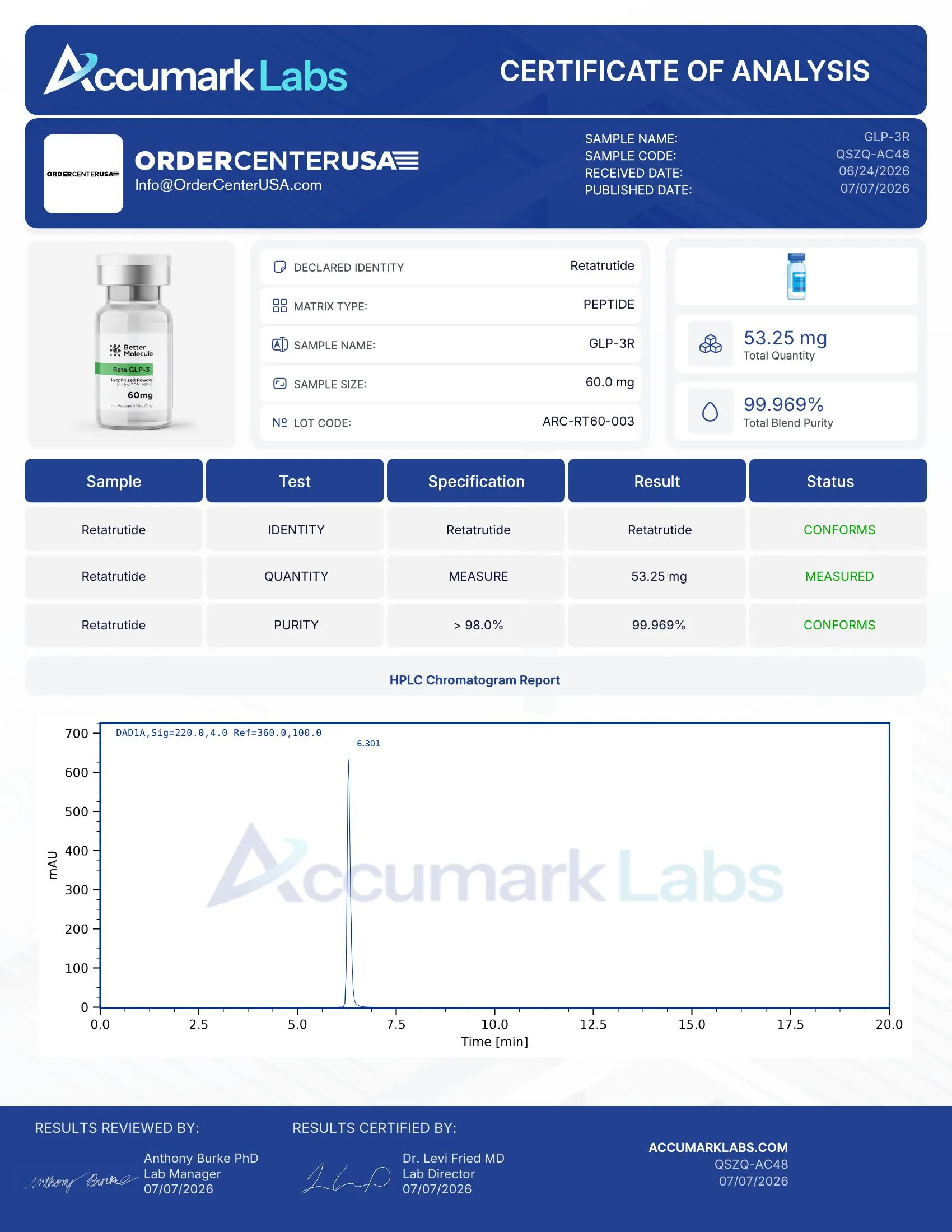
Every batch is produced and filled in the USA under tightly managed conditions to preserve integrity from synthesis through final packaging. Identity and purity are verified via third-party HPLC and MS, and each lot is traceable with detailed documentation. Vials are packaged to protect quality during transit and storage, incorporating tamper-evident features to support chain-of-custody requirements and accountable inventory control.
Use only in appropriately equipped laboratories by trained professionals. Follow institutional SOPs for reconstitution, labeling, storage, and disposal. Maintain intact vials in a controlled environment and protect from moisture and light until use. Adherence to validated procedures helps ensure consistent results and reliable data generation across experiments.
Better Molecule prioritizes precision at every step—sourcing, synthesis, filling, and verification—so your team can focus on capturing high-quality, reproducible findings. Our disciplined processes, transparent documentation, and responsive support reflect a commitment to purity, consistency, and trust. For laboratory research only. Not for human or animal use, medical, veterinary, or household applications.
- Most orders ship within 24 hours and arrive within 3 to 5 days of leaving our warehouse.
- Shipping is free on orders of $99+ (except Hawaii and Alaska).
- All orders ship in discreet packaging via USPS Ground Advantage mail.
Delivery restrictions vary by state.

This Product Contains

Customer Reviews
There are no reviews yet. Be the first to write a review!

Frequently Asked Questions
What is GLP-3 RT?
GLP-3 RT is not a standard pharmacology name, and on research-vendor sites it is often used as shorthand for a retatrutide-style multi-incretin compound. Because that naming is vendor-dependent, the exact identity should be checked on the product page or certificate of analysis. It should therefore be described cautiously as a multi-pathway metabolic research compound.
What is GLP-3 RT typically studied for?
Compounds sold under this label are generally discussed for appetite, glucose regulation, energy expenditure, and multi-receptor incretin signaling. A careful FAQ should avoid presenting the shorthand as if it were a formal drug name and instead tell readers to verify the exact active ingredient before designing research around it.
What are GLP peptides?
GLP peptides — glucagon-like peptides — are a family of peptides derived from the post-translational processing of the proglucagon precursor. The main members are GLP-1 and GLP-2, both of which are produced primarily by intestinal L-cells. GLP-1 is studied in the context of insulin secretion, glucose metabolism, and appetite signaling, while GLP-2 is investigated for its role in intestinal epithelial biology.
A number of synthetic analogs and research compounds exist in this category, including semaglutide-class and tirzepatide-class sequences, as well as dual- and triple-agonist research peptides. All GLP peptide products from Better Molecule are lyophilized research materials intended solely for in vitro laboratory investigation.
How do GLP analogs differ from native GLP hormones?
Native GLP-1 has a very short half-life in plasma — on the order of a few minutes — because it is rapidly degraded by the enzyme dipeptidyl peptidase-4 (DPP-4). GLP analogs are engineered peptides that modify the native sequence or attach additional groups such as fatty acid chains, in order to resist DPP-4 degradation, extend half-life, and optimize receptor binding.
This extended stability is what makes GLP analogs useful in research as practical tools for studying the GLP-1 and related receptor systems in controlled experiments. The analogs differ from native GLP hormones primarily in their pharmacokinetic profile and, in some cases, their receptor selectivity across the GLP-1, GIP, and glucagon receptor families.
What is the difference between GLP-1, GLP-2, and GLP-3 in research?
GLP-1 and GLP-2 are both produced from the proglucagon precursor. GLP-1 is studied in connection with the GLP-1 receptor, insulin secretion, and appetite signaling, while GLP-2 is studied primarily in connection with the GLP-2 receptor and intestinal epithelial biology. The two peptides share a common precursor but have different receptor targets and research focuses.
GLP-3 is not a classical endogenous peptide in the same way as GLP-1 and GLP-2. The term is sometimes used as a research label for engineered or triple-agonist peptides that combine activity at GLP-1, GIP, and glucagon receptors in a single molecule. In this sense, GLP-3 in research usually refers to a designed multi-target compound rather than a naturally occurring hormone.